
General Manager’s 2025 Annual Report
General Manager’s Message
On behalf of Niagara Transit, I am pleased to present the 2025 Annual General Manager’s Report. It was an exciting year in which we delivered on key priorities and made significant progress towards a more connected, efficient, and affordable transit system for Niagara riders.
Our most significant milestone of the year was the adoption of our Facilities, Strategic Asset, and Service Network 10-Year Master Plan. I want to thank our Board and our staff for their dedication and vision in bringing such a comprehensive and ambitious plan forward. I also want to recognize the community groups, hundreds of members of the public, local stakeholders and all of our riders who contributed to aligning our goals for this next decade with their needs and desires for transit service across Niagara. We have made great progress on transit in Niagara and still have much to do. This plan will guide us towards realizing a truly connected transit network that benefits all Niagara residents.
We also moved to one fare, anywhere - harmonizing fares across the system to open borders across the region to all our riders. Launching the Transit Benefit pass, we are making transit more affordable for those receiving Ontario Works, the Ontario Disability Support Program or for those who meet a low-income threshold.
Additionally, our on-time performance led our industry peers from across Canada, our ridership continued to significantly outpace our budget, and we celebrated the arrival of new vehicles to update our aging fleet and provide efficient and reliable service.
As always, I want to recognize the dedicated staff that make Niagara Transit the great service that it is for our riders. Their hard work and dedication is never taken for granted. They embody our organizational pillars and are the unwavering force that drives us forward.
- Service Excellence
- Safety
- Customer Focus
- Affordability
- Employee Success
The coming year will see continued strides being made for the communities we serve. We will add Sunday and holiday service across our entire network, introduce the Fort Erie community bus, achieve full service coverage in Niagara Falls and enhance our specialized service in St. Catharines and Thorold.
Thank you for your continued support of Niagara Transit. Together we are creating a truly connected community.
 |

Carla Stout, DPA
General Manager
|
2025 Board of Directors
| Chair Mayor Mathew Siscoe | St. Catharines |
| Vice-Chair Mayor Wayne Redekop | Fort Erie |
| Councillor Reg Freake | Grimsby |
| Councillor J.D. Pachereva | Lincoln |
| Councillor Joyce Morocco | Niagara Falls |
| Councillor Maria Mavridis | Niagara-on-the-Lake |
| Councillor Wayne Olson | Pelham |
| Councillor Eric Beauregard | Port Colborne |
| Councillor Dawn Dodge | St. Catharines |
| Councillor Caleb Ratzlaff | St. Catharines |
| Councillor Anthony Longo | Thorold |
| Mayor Brian Grant | Wainfleet |
| Councillor Leo VanVliet | Welland |
| Councillor William Reilly | West Lincoln |
| Regional Chair Jim Bradley | Niagara Region |
| CAO Ron Tripp | Niagara Region |
In memory of Jim Bradley

Niagara Transit is deeply saddened by the passing of Niagara Regional Chair, Jim Bradley. Chair Bradley had an indelible impact on Niagara and was a valued Niagara Transit Commission Board member since its inception. His dedication to our community will be greatly missed.
Mission, Vision, and Values
In 2024, the Niagara Transit Board adopted our mission, vision, and values. These will guide Niagara Transit now and in the future in all our decision-making and planning processes.
Mission
Providing safe, reliable, and sustainable transit service in Niagara.
Vision
Working together towards a more connected region.
Purpose
Helping every person in Niagara experience independence, freedom, and a sense of discovery.
Values
Service Excellence
Safety
Customer Focus
Affordability
Employee Success
Niagara Transit’s First Master Plan
2025 saw the adoption of the first 10-year Master Plan in our history. This plan lays out the framework for the needed expansion of transit in Niagara while remaining agile to respond to growth and change as it happens. Every community will benefit from better connectivity, enhanced transit hours, optimized routes, and greater availability.
What will the plan mean for Niagara?
- More “One-seat” Journeys
- Faster trips
- More frequent service
- Reduced trip denials on microtransit services
- Service enhancement in more marginalized areas
- Improved access and service efficiency
Introducing the Transit Benefit Pass

Transit is a social service that many individuals and families rely on across Niagara to access basic necessities, employment opportunities, education, healthcare and other critical services. When residents are struggling to make ends meet, one of their most significant costs is transportation.
The Transit Benefit Pass was launched at the beginning of July of 2025. 5,176 passes were sold through the program; 3,993 more than the previous discounted pass in the same period in 2024; that’s a 338% increase. To be eligible for the pass, residents must be collecting Ontario Works, Ontario Disability Support Program, or meet a low income threshold. It is estimated that close to 50,000 people are eligible in Niagara.
This program would not have been possible without the support of the Social Assistance and Employment Opportunities department at Niagara Region. It is a testament to the power of partnerships between Regional departments and service providers like Niagara Transit that the Benefit Pass was able to be realized and has been such a success.
The program is expected to continue it's rapid growth in 2026 and have an even greater positive impact on both those who are eligible for the pass and Niagara Transit. The pass is available at 11 locations across Niagara.

Launched Our Consolidated Fares
One fare... anywhere. This year beginning on July 1st we moved from separate regional and local fares of $6 and $3 to a single fare of $3.50. This change was also reflected in our 10-ride and 31-day transit passes.
Niagara residents can now travel anywhere on any of our services for the same affordable price. The move to a single fare was a key strategy proposed during the triple-majority process that amalgamated transit in Niagara. It was identified as an important change in multiple pre-amalgamation studies on both service delivery and governance.
Having a single fare simplifies navigating transit for riders, enhancing the overall experience. It addresses inequality and makes the region more affordable for everyone, opening up opportunities for employment, education, residence, and much more. It also reduces operational complexity, simplifying fare collection and reducing administrative work.
The simplified structure attracts more riders and in turn supports local businesses and economic development. It will support the continued sustainability of Niagara Transit and increase our ability to plan and implement the new 10-year Master Plan. Additionally, as our staff meet regularly with the Provincial-Municipal Fare Strategy Implementation group, it prepares us for possible future integrations with the Ontario One Fare program and potentially moving to Presto as our fare collection system.

Service Excellence
Continued Strong Conventional Service Delivery and OTP
This year we continued our strong, above industry average service on our conventional routes. Our team delivered over 99.9% of every trip scheduled for the year and improved our on-time performance (OTP) to 84% on conventional, and 93% on our commingled service. The average OTP for peer transit services this year in Ontario was 81%. New buses and other service enhancements contributed to another strong year and we plan to continue this trend in 2026!

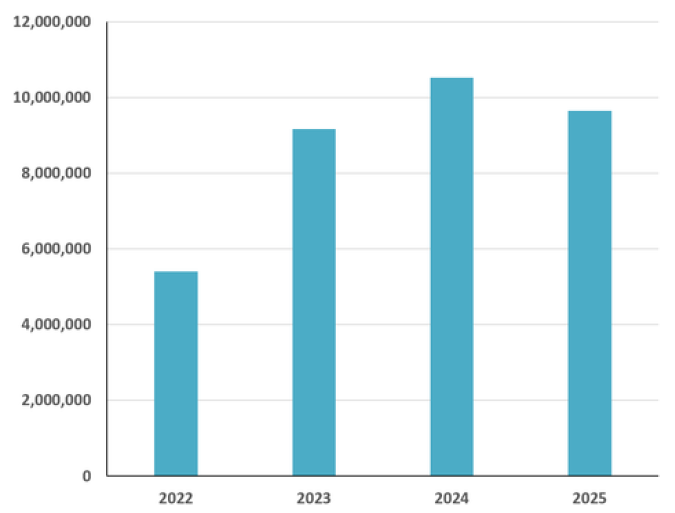
Ridership Continues to Top 10 Million Trips
In 2025, post-secondary UPASS ridership was affected by the federal government's decision to limit international student visas. While this led to a reduction of service to Niagara College, increases in non-student ridership meant that Niagara Transit delivered more than 10 million trips again in 2025!
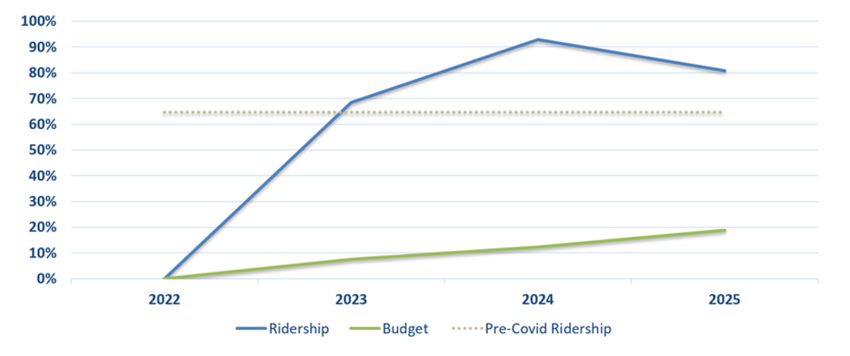
While previously, the largest ridership group on transit had been students, regular adult fares have now surpassed student UPASS trips for the second year running, up +11% in 2025. Ridership continues to significantly outpace budget increases, demonstrating that transit is being delivered efficiently and effectively in Niagara. As we work toward realizing the targets within the 10-year Master Plan we expect ridership to continue it’s strong growth!
Ridership Increase versus Budget Increase Since Amalgamation

New Buses Delivered!
If you think you’ve seen more buses around your neighbourhoods with our new Niagara Transit branding... you’re right! In 2025, we took delivery of 27 new buses. In addition to looking great, they replaced aging buses in our fleet and will contribute to better fuel economy, fewer repairs needed and increased uptime. To purchase new buses, we used key federal and provincial funding to minimize the cost to taxpayers. Watch for even more to arrive in 2026!


New Service to Dain City
As part of our efforts to expand conventional service to new areas within our existing resources, this year, Route 25, the Port Colborne Link, was rerouted to bring hourly service to residents of Dain City. This connects the area to both Welland and Port Colborne and reduces the area’s reliance on our microtransit system. This also frees up capacity for our microtransit in that area and across Welland. This change is an example of our continuous system improvement and what riders can expect as we implement the master plan!
Boosting Reliability
A significant focus this year was on improving our reliability. Through new maintenance programs, the introduction of new vehicles, and reduced absenteeism, we were able to achieve only 444 missed trips out of over 1,165,900 scheduled times when a bus departed an NT facility. Our significant downward trend through the year (Q1: 268, Q2: 99, Q3: 38, Q4: 39) means we’re looking forward to continued improvement in 2026.

Safety
Introduction of the Safe Driver/Worker Program
In 2025, we were excited to introduce a program to further enhance our commitment to safety. The Safe Driver/Worker Program recognizes individuals within the organization who have had zero preventable collisions, on-board injuries, or preventable claims within the calendar year. It is another way to recognize and promote safe driving and safe practices in all areas of Niagara Transit and will be completed each year moving forward.


System-Wide Bus Stop AODA Assessment
During the summer of 2025, we completed a full review of our over 1,800 bus stops across Niagara to assess their compliance with provincial accessibility standards. This was an important step toward bringing, where possible, the needed improvements that make Niagara Transit’s service more accessible to all residents. Niagara Transit will continue to make improvements in accordance with our Multi-Year Accessibility Plan.
Welland Security Camera Replacement
Surveillance is a key safety tool for preventing incidents, enabling timely responses and proper records when they occur. This year, we replaced aging cameras at the Welland Terminal with ones that provide a clearer, more complete view of the property. They are visible to riders and already appear to be acting as a strong deterrent. It also means we are better able to assist Niagara Regional Police when incidents do occur.


Successful 3rd Party Safety Audit
In 2025, Niagara Transit successfully completed an independent health & safety audit conducted by Langlois Safety & Training Consulting Services. The purpose of the audit was to ensure NTC’s compliance with all related health and safety legislation, underscoring our continued commitment to a safe and accountable workplace and transit system.
Eliminated Radio Dead Zones
Communications between our bus operators, supervisors and other staff are a critical component of safety. Since amalgamation, areas of the region have had dead zones where operators were out of touch. In 2025, we improved our tower coverage, and we now have full coverage of our routes across the region!


Replaced In-Ground Hoists In St. Catharines
Safety at our facilities was improved this year by replacing hoists at our St. Catharines garage. The new hoists protect our fleet maintenance crews by keeping workers from standing near buses while they’re being raised, reducing the potential for serious accidents.
Boosting Safety at Our Facilities
This year, we implemented facility upgrades, including new panic buttons at the St. Catharines, Niagara Falls and Welland terminals. This allows staff to set off an audible alarm and notify Niagara Regional Police to attend the site immediately. We have also added access control and security staff to the Welland terminal.

Customer Focus
Strong Community Engagement
2025 saw Niagara Transit out and active in all our communities across the region. We participated in 92 engagements and presentations to various community groups and stakeholders. This included seniors groups, libraries, student groups, sporting groups and community centres. We also actively attend committee meetings such as Accessibility and DEI committees to gather feedback. We will be back out and visiting your community in 2026.


Successful Niagara College Referendum
The Niagara College Student Administrative Council (NCSAC) had an important referendum in 2025 asking students if they still wanted to participate in the UPASS program. Niagara Transit staff worked to educate UPASS riders about what the changes would mean. Students voted overwhelmingly to keep the UPASS program, with 84% voting yes.
Completed Multi-Year Accessibility Plan
This year, the NTC Board passed our finalized multi-year accessibility plan (MYAP) for 2025-2029. The MYAP will establish a comprehensive roadmap to meet accessibility, inclusivity, and compliance targets across the organization and for the riding public for Niagara Transit’s suite of 100% accessible transit services.


St. Catharines Terminal Facelift
This year, we completed a series of needed cosmetic repairs to our St. Catharines Downtown Terminal. Riders will benefit from an improved atmosphere both inside and outside of the building. New programs have been implemented to ensure the terminal looks its best moving forward.
Affordability
Utilizing Federal and Provincial Funding
The federal and provincial governments play a key role in transit funding. Municipal budgets are limited, and creating a comprehensive transit network would not be possible on our own. In 2025, we made exciting announcements about $93M in ICIP and $35M in CPTF funding, which will be critical for capital replacement and necessary facility upgrades.


Stabilization Reserve Ahead of Schedule
The stabilization reserve is critical to ensure that any one-time, extraordinary costs or year-end deficits can be covered. Recent events like the COVID-19 pandemic have shown how critical it is to plan for unexpected events. Surpluses in our first few years of operation have enabled us to build the stabilization reserve ahead of schedule and ensure that future, unexpected costs are mitigated for riders and taxpayers.
ICIP Funds Transition
In 2025, we obtained NTC Board approval to seek to repurpose funds from the Investing in Canada Infrastructure Program (ICIP) that had been uploaded by local municipalities as part of the amalgamation. Moving into our fourth year of service, new priorities have been identified, and aligning our ICIP funding with these priorities will ensure we can deliver on them while keeping local costs down.


Proud Members of the Poverty Reduction Committee
Niagara Transit serves residents from all walks of life. We are proud to take an active role on the Niagara Poverty Reduction Strategy Steering Committee. Transit is vital for those experiencing poverty, connecting them with employment opportunities, healthcare, and social services, and enabling their participation in their community.
Employee Success
A Focus on Training
Providing training for our employees is critical to their success and to the organization's success. We are always actively training and refreshing skills for our operators, supervisors, and other staff to ensure we provide the best service to riders. Training highlights from this year include critical incident stress management and incident note-taking for our supervisors. This will help our supervisors excel in these critical areas and assist the employees in their care.


We Brought Back the Bus Roadeo!
This year, we reintroduced the Roadeo. It was a fun weekend event for our operators to show off their skills, and for staff from across the organization to get together to celebrate our successes. Drivers piloted their bus through a challenging, timed course that featured tight turns, narrow straights and pinpoint reversing, scoring points for each section. Congratulations to our winner, Mike Horner, for taking the bus by the horns!
Performance Assessment Program
Feedback is an important part of the development and career success of all employees. Being completed in 2026 for the 2025 year, Niagara Transit has introduced a performance assessment program for the first time. This will provide non-union employees with an opportunity to highlight their performance and receive structured feedback from their direct supervisor.


Rudolph (The Bus) Came to Town!
Our employees and the communities we serve joined in some Niagara Transit holiday fun this year! We participated in local Christmas parades, bringing the Rudolph bus to visit 9 of our local communities. It was a fun way for our operators and staff to engage with residents across the region and add a little holiday cheer from NT! Rudolph the bus will be coming back to visit in 2026!
What's Next in 2026?
Sundays and Holidays Across the Network
The most common request we have heard since amalgamation has been to add Sunday and holiday services across the network. Previously, regional routes and our microtransit services in many communities operated only Monday-Saturday, not on statutory holidays. We are excited that, as of September 2026, our full network will be available 365 days a year. This was a key pillar of the amalgamation and will benefit all our riders, especially those who use transit to access employment opportunities.


Re-Introducing the Fort Erie Community Bus
Fort Erie has seen consistently high and growing ridership on our microtransit service. In 2025, we delivered more than 100K trips in Fort Erie. In May 2026, the Route 22 - Fort Erie Link schedule will run for the full day and be interlined with the newly created Fort Erie community bus route. This will provide consistent service to the areas most frequently visited in town and allow residents to reach the new South Niagara Hospital without changing buses.
Advocacy
In 2026, we plan to build on our advocacy through a variety of avenues. We are active members of the Ontario Public Transit Association and Canadian Urban Transit Association and will continue to join their efforts to call for more capital and operating support for transit from higher levels of government. We are submitting another round of pre-budget submissions to the federal and provincial governments that will outline our priorities for the year. We will also connect with decision makers at events such as the AMO Conference and OPTA’s Queen’s Park Lobby Day.


Full Transit Coverage for Niagara Falls
When Niagara Transit was amalgamated, certain areas hadn’t previously received transit service. Niagara Falls Transit did not have service outside the urban boundary. This meant residents were unable to access areas like Fireman’s Park and other community spaces. For 2026, Niagara Falls Council supported the inclusion of all areas of the city, and it was included in the budget to begin this year.
Improved Specialized Service in St. Catharines and Thorold
St. Catharines and Thorold have seen increased demand for our specialized transit service, and in 2026, we’re improving our capacity to meet it. More space for riders will mean more availability and shorter trips! Look out for our enhanced capacity starting in May.


Additional Supervision in Operations
On-road supervisors are important for safety and customer service. Niagara is a uniquely large land area to cover and requires enough supervisors to be able to cover that area and respond to issues in a reasonable timeframe. This year we will be adding a supervisor to our team to ensure we are able to meet the needs of our growing network!
Entire Fleet Branded
Completing the harmonization of our Niagara Transit branding is an important step we’re excited about in 2026. It will be finished across all our vehicles, including conventional, microtransit, and non-rider vehicles, and will help increase awareness and understanding that we are now a unified, regional system.

2025 Key Performance Indicators
2025 Efficiencies Highlights
Fleet Role Optimization
Aligned roles and responsibilities to improve productivity, streamline operations and drive continuous improvement.
Fare Harmonization
Harmonized fare products and pricing to improve customer clarity and reduce operational complexity.

Technology-Enabled Efficiency
Implemented IT helpdesk software to streamline service workflow, and expanded the use of Power BI to automate reporting and enable timely, data-driven decision‑making.

Group Purchasing and Strategic Sourcing
Achieved cost savings across IT and other commodities by leveraging competitive procurement processes and group purchasing arrangements to capitalize on economies of scale.
2025 KPI's
Reliable and Consistent On-Time Conventional Service:
- Over 99.9% service delivery
- On-Time Performance of 84% Conventional vs. 81% industry peer average, and 93% Micro/Specialized
Ridership Increase vs Budget Increase Since Amalgamation
Cost Per Ride
| 2022 | 2023 | 2024 | 2025 | |
| Ridership | 5.6 million | 9.5 million | 10.9 million | 10.0 million |
| Cost per Ride | $8.06 | $5.57 | $5.22 | $6.04 |
| Cost per Ride (excluding Capital Reserve) | $5.34 | $5.02 | $5.61 |
(Blended rate for all transit services)
Niagara Transit Snapshot
| Number of Local Routes | 88 |
| Number of Intermunicipal Routes | 11 |
| 2025 Staff* | 453 |
| Number of 40' buses | 139 |
| Number of 60' buses | 22 |
| Average age of 40' buses | 6.7 |
| Average age of 60' buses | 8.2 |
| Number of specialized transit buses | 23 |
| Average age of specialized buses | 7 |
| Number of support vehicles | 39 |
*2025 Budgeted Full Time Equivalent staff, including temporary staff
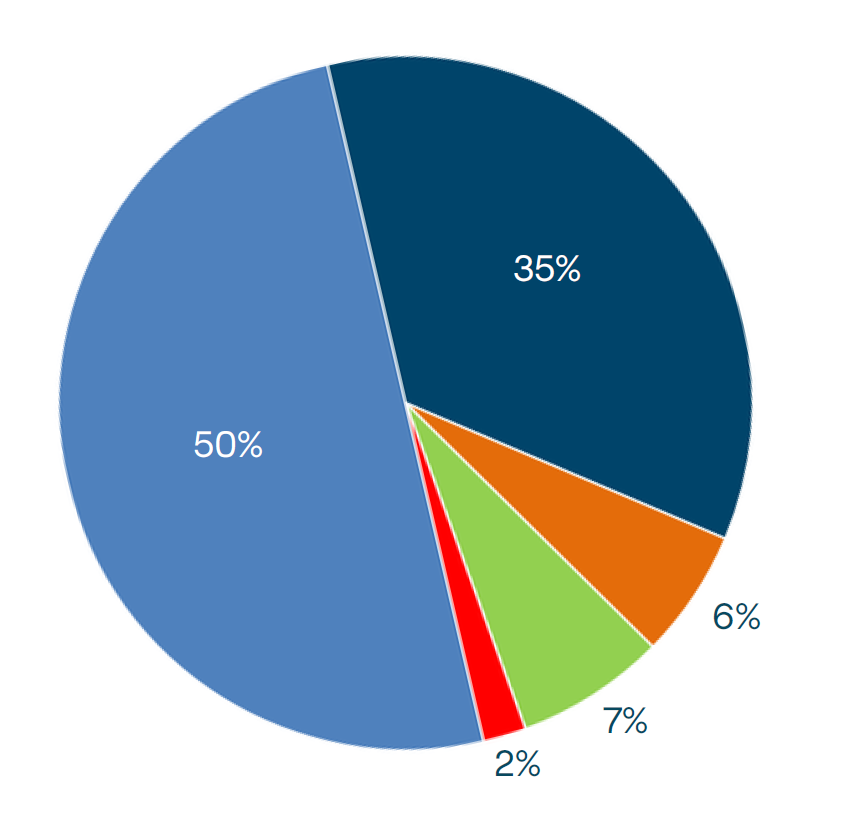
Who Rides Our System?
| Classification | Definition |
|---|---|
| Adult 50% | 18+ |
| Post-secondary Student 35% | Brock University & Niagara College |
| Youth 7% | 13 to 17 |
| Child 2% | Under 12 |
| Senior 6% | 65+ |
Conventional Ridership
| Ridership Per Revenue Vehicle Hour | Revenue Vehicle Hours Per Capita | |
|---|---|---|
| 2023 Prov. Avg* | 21.7 | 1.2 |
| 2024 Prov. Avg* | 22.5 | 1.2 |
| 2024 NTC | 23 | 1.1 |
| 2024 NTC | 20.2 | 1.1 |
* The Provincial Average is based on Canadian Urban Transit Association Data, comparing similar-sized Transit Agencies (population 100k to 750k)
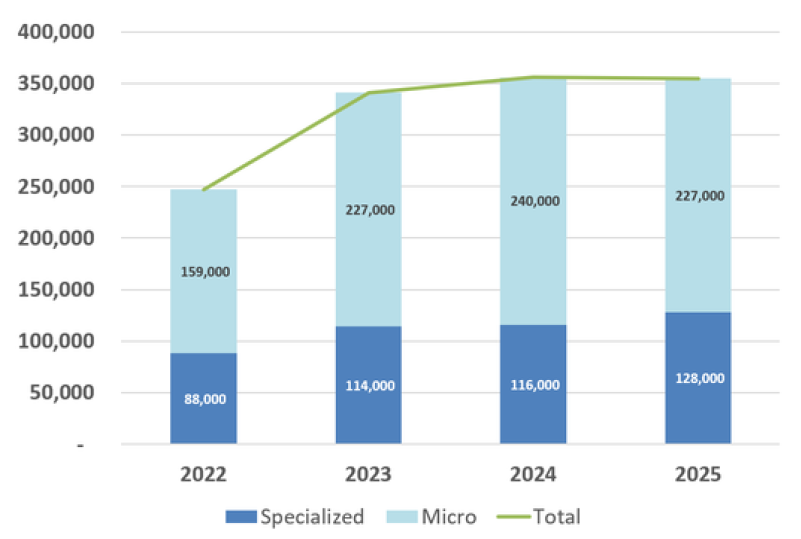
Specialized and Microtransit Ridership
| Specialized Transit | Microtransit | ||
|---|---|---|---|
| Ridership Per Revenue Vehicle Hour | Revenue Vehicle Hours Per Capita | Ridership Per Revenue Vehicle Hour *** | |
| 2022 Prov. Avg* | 1.9 | 0.2 | n/a |
| 2023 Prov. Avg* | 2.3 | 0.2 | n/a |
| 2024 Prov. Avg* | 2.2 | 0.2 | n/a |
| 2023 NTC | 1.7 | 0.1 | 2.8 |
| 2024 NTC | 1.8 | 0.1 | 2.9 |
| 2025 NTC | 2.0 | 0.1 | 2.5 |
*Provincial Average is based on Canadian Urban Transit Association Data, comparing similar-sized transit agencies (population 100k to 750k)
| Specialized & Microtransit | |
|---|---|
| Average Time on Vehicle1 | 18 mins |
| On Time Pecentage | 93% |
| Average Distance per Trip | 9.4 km |
| Average Wait Time * | 7 mins |
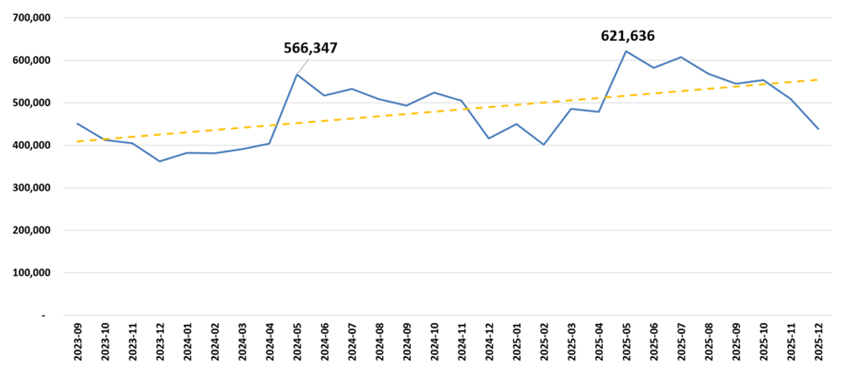
2023 to 2025 Boardings (Non-UPASS)
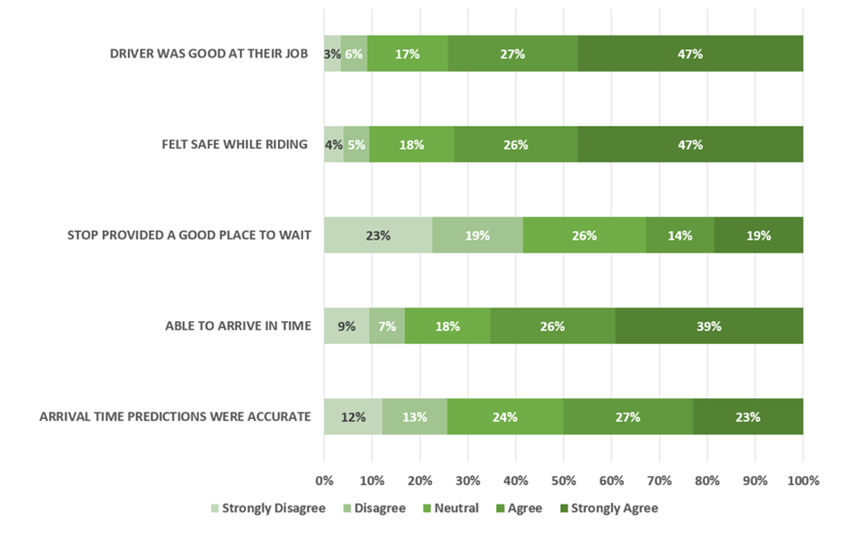
Rider Safety & Service Survey
2025 Distances Covered
| Total Annual Km Driven - Conventional | 10,245,686 |
| Total Annual Km Driven - In-House Specialized | 817,640 |
| Average Annual Km Driven per Conventional Vehicle | 63,638 |
| Average Annual Km Driven per Specialized Vehicle | 35,550 |
In 2025...
In total, our buses drove 255 times around the earth!
Over 13 times to the moon and back!
Each bus drove an average of 1.5 times around the earth!
Or across Canada 8.5 times!
Download the PDF
